

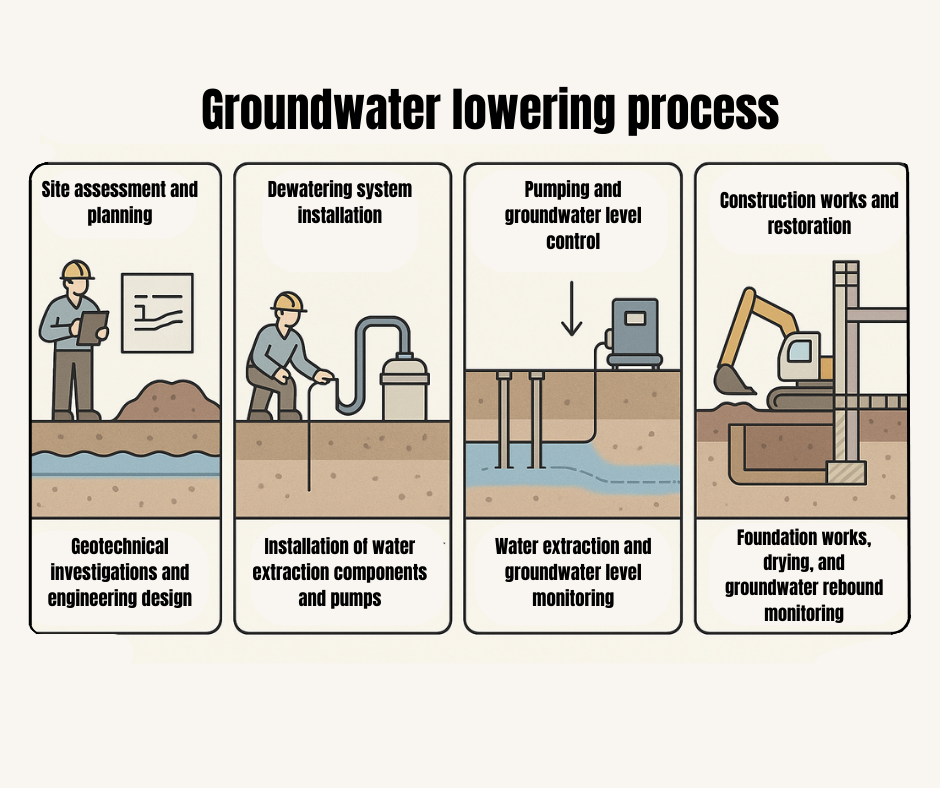
The purpose of groundwater lowering is to temporarily reduce the groundwater level below the level of the substructure for the duration of construction works. This is essential during deep foundation works, the construction of basements, shafts, and deep-laid utilities—whether for linear infrastructure projects such as sewer or drinking water pipelines, or for the foundations of residential buildings and industrial halls.
Each project is preceded by thorough geotechnical investigations, during which we determine soil layer characteristics, permeability, and the current groundwater level. Based on these findings, we prepare an engineering plan that defines the dewatering method (e.g. vacuum wellpoint system, open pumping system, or driven drainage system), the equipment to be used, and the required operating water level.
At the construction site, we install the necessary water extraction components, including vacuum wells, drainage pipes, collector trenches, and pumps. In the case of linear infrastructure projects—such as sewer construction—continuous and uniform groundwater level reduction along the entire route is particularly important.
Pumping begins immediately after system installation, with continuous monitoring and regulation of the groundwater level. This ensures that the work area remains dry and safe throughout the process and does not jeopardize structural works such as slab foundations, strip foundations, or pile foundations.
Under stable conditions, foundation and other deep construction works are carried out. Upon completion, water extraction is gradually stopped, groundwater rebound is monitored, and—if necessary—additional compaction or injection is performed to stabilize the surrounding soil.
Extracted water is always handled in compliance with applicable regulations. This may include pre-treatment, sedimentation, or discharge into an approved receiving body—especially in populated areas or near natural water bodies.
Our company has proven its ability to meet the speed and reliability requirements of clients working under tight deadlines through the successful dewatering of numerous excavation pits and linear infrastructure projects. Our experienced professionals are also prepared to handle difficult-to-dewater soils and strongly layered ground conditions. Rapid mobilization and the high efficiency of our wells are ensured through machine-driven rotary drilling with water flushing.
With our fleet of 14 Hüdig vacuum units and their associated wells and collector pipelines, we are capable of dewatering up to 2 km of alignment simultaneously. As all works are carried out in-house without subcontractors, we offer our clients a reliable partnership, consistently high-quality execution, and strictly met deadlines—even under challenging conditions and complex project requirements.
3 Fiat Hitachi universal excavators (with attachments)
1 Caterpillar 260D upper-structure drilling machine (with attachments)
14 vacuum units with associated wells and collector pipelines
2 high-performance power generators
Additional tools and equipment required for on-site operations